
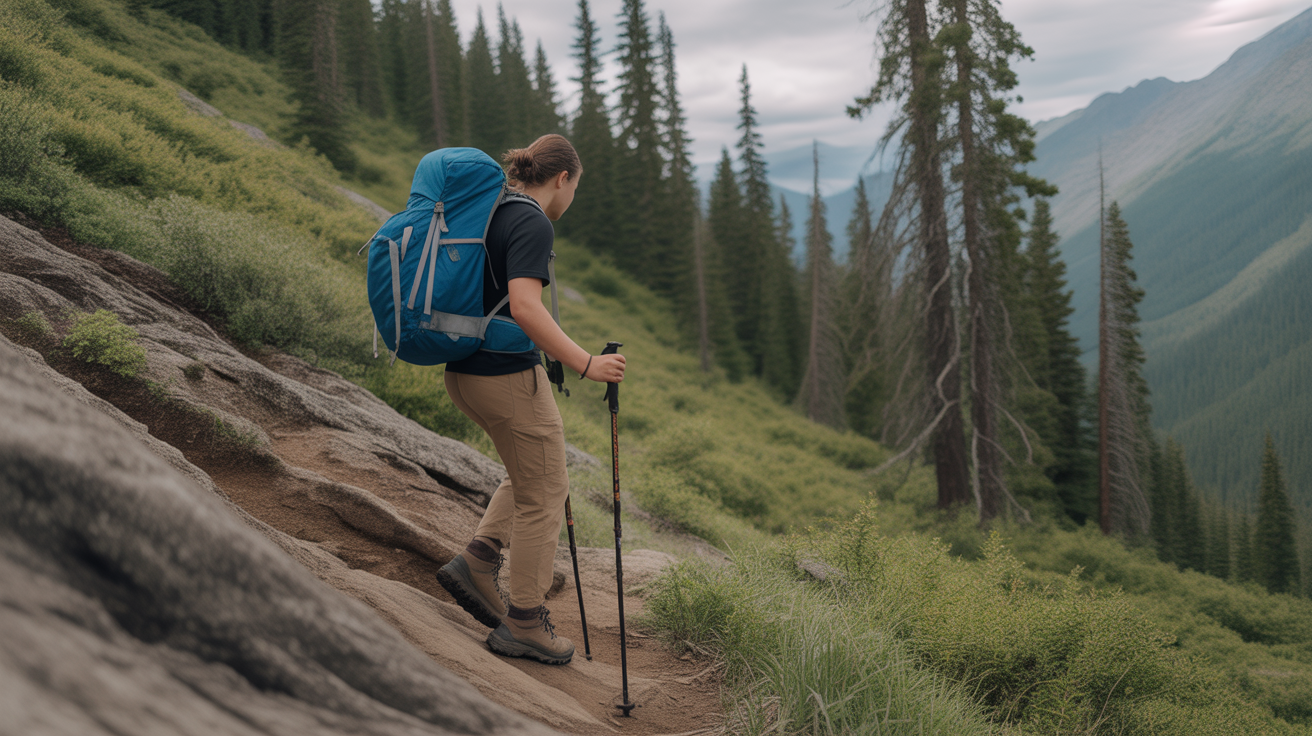
If your knees start complaining on downhill sections, you are not alone. Knee discomfort on the trail is one of the most common reasons hikers look for extra support. Walking sticks provide additional points of contact with the ground, which helps distribute your body weight across more than just your legs. This weight distribution is most noticeable on steep descents or uneven terrain.
This guide covers five walking stick options specifically chosen for hikers managing knee discomfort. We focus on features that matter most when you need reliable stability and weight distribution – adjustable height systems, shock-absorbing materials, secure locking mechanisms, and comfortable grips for extended use. Whether you are dealing with occasional soreness or want additional support on challenging trails, you will find a practical recommendation that fits your hiking style and budget. Walking sticks are tools for better weight distribution and stability, not medical devices – if you have persistent knee pain, consult with a healthcare provider about appropriate treatment.
What to Look For
Adjustable Height and Proper Fit
Pole height affects your posture and how you distribute weight while hiking. When your poles are too short, you lean forward and put more pressure on your legs. When they are too long, you lose stability and strain your shoulders.
For flat terrain, your elbow should form a 90-degree angle when holding the pole with the tip on the ground. For uphill climbs, shorten the poles by 2-3 inches to maintain balance without overreaching. For downhill sections, lengthen the poles by 2-3 inches so you can plant them ahead of you and brace through your arms instead of your legs.
Look for poles that adjust easily without requiring tools or excessive force. Flip-lock systems let you change height quickly between terrain changes. Twist-lock systems tend to be lighter but can loosen during use if not tightened properly. The adjustment range matters too – if you are taller than 6 feet or shorter than 5 feet 2 inches, verify the pole extends or collapses enough to fit your frame.
Shock Absorption Features
Shock absorption reduces the impact that travels up the pole into your wrists, elbows, and shoulders with every plant. Some poles include internal spring mechanisms that compress slightly on impact. This is most noticeable on hard-packed trails, pavement, or rocky descents. Other poles use materials like carbon fiber that naturally dampen vibration better than aluminum. Carbon fiber poles tend to cost more but feel noticeably smoother on repetitive impacts.
If you hike primarily on soft dirt trails or grass, shock absorption matters less. If you hike on mixed terrain with rocks, roots, or occasional pavement crossings, the difference becomes more apparent over a few miles.
Material: Aluminum vs Carbon Fiber
Aluminum poles are durable, affordable, and bend rather than break under stress. If you catch a pole between rocks or apply uneven pressure, aluminum will usually bend and remain functional enough to finish your hike. Aluminum poles typically weigh between 8 and 10 ounces per pole.
Carbon fiber poles weigh less – often 6 to 7 ounces per pole – and absorb trail vibration better than aluminum. This makes them easier on your joints during long descents. The tradeoff is cost and durability under side impact. Carbon fiber can crack or snap if twisted or struck at an angle, though it handles vertical compression well.
For hikers who cover rocky or hard trails frequently, the vibration-dampening quality of carbon fiber offers a noticeable advantage. If you are newer to poles or hike occasionally, aluminum offers better value and forgiveness.
Grip Material and Comfort
You will hold your poles for the entire hike, so grip comfort matters more than it seems. Cork grips mold to your hand shape over time and wick moisture away naturally, which prevents blisters on sweaty days. EVA foam grips feel soft immediately and insulate your hands in cold weather, but they absorb sweat and can become slippery.
Some poles include extended grips below the main handle, which let you choke up on steep climbs without adjusting pole length. This is useful when terrain changes frequently and you want to avoid constant readjustment.
Rubber grips are less common on trekking poles but appear on some budget models. They are durable but do not absorb moisture, so your hands can slip during exertion.
Locking Mechanism Reliability
A pole that slips mid-stride can throw off your balance and put sudden stress on your legs. Flip-lock systems use external clamps that you can tighten or loosen without tools. They are fast to adjust and easy to check visually while hiking. If a flip-lock starts to slip, you can usually tighten it on the trail with your fingers.
Twist-lock systems are lighter and create a cleaner pole profile, but they require more hand strength to tighten properly and can loosen gradually during use. If your hands tire easily or you have arthritis, flip-locks are generally easier to manage.
Some poles use a folding Z-pole design with fixed segments connected by cord. These do not adjust for height but pack down extremely small. They work well if you want poles for occasional use or emergency backup, but they lack the height versatility that helps optimize support on varied terrain.
Tip Design and Terrain Compatibility
Most walking sticks come with carbide or steel tips designed for dirt, rock, and packed trails. These tips bite into the ground and provide the traction you need to push off or brake on descents. For pavement or smooth rock, removable rubber caps protect the tip and reduce noise, though they offer less grip.
Baskets – the small discs above the tip – prevent poles from sinking into soft ground like mud, sand, or snow. Standard hiking baskets are small (around 2 inches wide) and work for three-season hiking. If you hike in snow, larger baskets prevent the pole from punching through the surface, but you can usually purchase those separately if needed.
Our Top Picks
1. TrailBuddy Trekking Poles
Best overall for reliable support with proven durability

With over 63,000 reviews and a 4.7-star rating, the TrailBuddy poles have become a go-to choice for hikers who want extra stability on the trail. These poles use aluminum construction, which strikes a practical balance between durability and weight. The aluminum handles vertical compression well and will bend rather than snap if you catch the pole awkwardly between rocks – a reassuring quality when you are relying on these for stability on uneven descents.
The cork grips mold to your hand shape over time and pull moisture away from your palms naturally, which matters on longer hikes when your hands start to sweat. Below the main cork grip, you will find an extended foam section that lets you choke up on steep climbs without stopping to adjust pole height. This is particularly useful when terrain shifts frequently between flat sections and short, steep pitches.
The flip-lock adjustment system uses external lever clamps that you can tighten or check visually while hiking. If a lock starts to feel loose after a few miles, you can snug it up without tools or excessive hand strength. The poles adjust from 24.5 inches to 54 inches, which accommodates most adult heights and allows the length changes you need between uphill and downhill sections.
Each pole comes with interchangeable tips and baskets for different terrain types. The carbide tips bite into dirt and rock effectively, and the included rubber caps protect the tips and reduce noise on pavement or when storing the poles. The poles collapse into three sections for packing, though they do not fold as compactly as Z-pole designs.
Aluminum transmits more trail vibration into your hands and wrists compared to carbon fiber, though the cork grips help dampen some of that feedback. For the price point and proven reliability across tens of thousands of users, these remain a strong choice for hikers who want dependable support without premium pricing.
See current pricing for the TrailBuddy Trekking Poles on Amazon.
Pros
- Over 63,000 verified customer reviews provide extensive real-world feedback
- Cork grips naturally wick moisture and conform to your hand over time
- Flip-lock system adjusts quickly and can be tightened on the trail without tools
- Extended foam grip below the handle for easy height choking on climbs
- Aluminum construction bends under stress rather than snapping
Cons
- Heavier than carbon fiber alternatives
- Aluminum transmits more trail vibration than carbon fiber options
- Three-section collapse is bulkier than folding Z-pole designs
2. Foxelli Carbon Fiber Trekking Poles
Best for reducing joint vibration on rocky or hard-packed trails

The Foxelli carbon fiber poles stand out for hikers who cover rocky descents or hard-packed trails frequently. Carbon fiber naturally absorbs more trail vibration than aluminum, which reduces the cumulative stress that travels up through your wrists, elbows, and shoulders with every pole plant. Over a few miles of downhill hiking, this difference becomes noticeable in how your upper body feels.
The cork grips are comfortable right out of the package and wick moisture effectively during long hikes. The quick flip-lock adjustment system uses external lever clamps that are easy to operate and hold securely once tightened. The poles adjust from 24 inches to 55 inches, covering a wide height range for different users and terrain adjustments.
Carbon fiber is lighter than aluminum, which you will notice most on longer hikes or when carrying the poles on your pack during flat sections. The poles collapse into three sections and come with a carrying case, plus multiple tip and basket options for different terrain.
The main consideration with carbon fiber is durability under side impact or twisting force. While these poles handle vertical compression extremely well – which is how you use them during normal hiking – they can crack if caught at an angle between rocks or if you fall on them awkwardly. You will want to treat these with slightly more care than aluminum poles.
The flip-locks occasionally require retightening after a few hours of hiking, particularly when new. This is common across most trekking poles with external clamp systems and takes only a few seconds to address on the trail. Once the locks break in after a few hikes, they tend to hold more consistently.
For hikers who cover rocky terrain frequently or who notice hand and wrist fatigue with aluminum poles, the vibration dampening of carbon fiber offers a tangible benefit. The price premium over aluminum is moderate at this level, making these a practical upgrade if upper body comfort during long descents is a priority.
Read verified buyer reviews for the Foxelli Carbon Fiber Trekking Poles on Amazon.
Pros
- Carbon fiber construction dampens trail vibration better than aluminum
- Cork grips wick moisture and remain comfortable during long hikes
- Lighter than most aluminum poles
- Flip-lock system adjusts quickly and holds securely when tightened
- Wide adjustment range from 24 to 55 inches fits most adult heights
Cons
- Carbon fiber can crack under side impact or twisting force
- Flip-locks may require periodic retightening during the first few hikes
- Higher price point than aluminum alternatives
3. Cascade Mountain Tech Trekking Poles
Best budget pick for new pole users seeking additional stability

The Cascade Mountain Tech poles deliver reliable support at a price point that makes sense if you are new to using walking sticks or want to test whether poles help your hiking before committing to premium options. With over 14,000 reviews, these have proven themselves with a wide range of hikers who need stability without breaking the budget.
These poles use aluminum construction, which provides durability and forgiveness if you plant a pole awkwardly or catch it between rocks. The aluminum will bend under excessive force rather than snapping, which gives you more margin for error while you are learning proper pole technique. The cork grips are comfortable for extended use and pull moisture away from your palms naturally, similar to grips found on poles costing twice as much.
The extended grip below the main handle – a longer foam section that wraps several inches down the shaft – lets you choke up on steep climbs without stopping to adjust pole length. This is particularly useful on rolling terrain where you encounter short, steep sections between longer flat stretches. The flip-lock adjustment system uses external lever clamps that adjust quickly and are easy to check or tighten while hiking.
The poles adjust from 26 inches to 54 inches, which covers most adult heights and allows the length changes you need to optimize support on different terrain. Each pole comes with interchangeable carbide tips, rubber tip protectors, trekking baskets, and snow baskets. This complete accessory kit means you can adapt the poles for different seasons and trail conditions without purchasing additional parts.
The main tradeoff at this price point is weight. These poles are noticeably heavier than carbon fiber options. The flip-locks can require retightening during longer hikes, particularly when the poles are new. This is common across most external clamp systems and takes only a moment to address on the trail. Once the locks break in after several hikes, they tend to hold more consistently.
For hikers who want to see whether poles make a meaningful difference for their hiking experience without spending premium prices, these offer solid performance and proven reliability across thousands of users. They provide the core features that matter – adjustable height, comfortable grips, secure locks, and durable construction – at a price that removes the financial barrier to entry.
Check current stock for the Cascade Mountain Tech Trekking Poles on Amazon.
Pros
- Budget-friendly price point makes poles accessible for first-time users
- Over 14,000 reviews indicate proven reliability
- Cork grips and extended foam section provide comfortable hand positions
- Complete accessory kit includes tips and baskets for multiple terrain types
- Aluminum construction is durable and bends rather than breaking
Cons
- Heavier than mid-range aluminum and carbon fiber alternatives
- Transmits more trail vibration than carbon fiber options
- Flip-locks may require periodic retightening during longer hikes
4. BLACK DIAMOND Trail Trekking Poles
Best for hikers who want proven brand reliability and secure locking

Black Diamond brings decades of mountaineering and trekking experience to these poles, and that heritage shows in the build quality and attention to detail. For hikers who want confidence in their gear, the brand reputation and FlickLock Pro adjustment system offer reassurance on technical descents where stability matters most.
The FlickLock Pro system uses Black Diamond’s proprietary external clamp design, which is engineered to hold more securely than standard flip-locks and resist slipping during aggressive downhill braking. The locks adjust with a simple lever flip and can be fine-tuned for tension without tools. Once set, they hold reliably through long descents and rough terrain.
These poles use a three-section telescoping design that adjusts from 25 inches to 55 inches. The grips include an extended lower section for choking up on steep climbs. The carbide tips bite effectively into dirt, rock, and packed trails. Black Diamond includes trekking baskets with each pole, and you can purchase snow baskets separately if you hike in winter conditions.
The primary consideration here is price. At nearly double the cost of budget aluminum poles, you are paying for brand heritage, refined engineering, and the confidence that comes with Black Diamond’s reputation in technical outdoor gear. The poles also have fewer customer reviews than some competitors, though the 4.6-star average from over 600 users indicates strong satisfaction among those who have purchased them.
For hikers who prioritize secure locking mechanisms and want the reliability of a proven outdoor brand, these poles deliver the stability and confidence you need when tackling challenging terrain. The investment makes most sense if you hike frequently or tackle steep, technical descents where pole reliability directly affects your safety and comfort.
Compare the BLACK DIAMOND Trail Trekking Poles specs and pricing on Amazon.
Pros
- FlickLock Pro system holds securely and resists slipping on steep descents
- Black Diamond brand reputation provides confidence in build quality
- Extended lower grip section for choking up on steep climbs
- Carbide tips and included trekking baskets handle varied terrain
- Wide adjustment range from 25 to 55 inches
Cons
- Limited customer feedback compared to other options with significantly higher review counts
- Higher price point than most aluminum alternatives
- Heavier than carbon fiber poles and transmits more trail vibration
5. TheFitLife Nordic Walking Trekking Poles
Best entry-level option with anti-shock feature for pavement and hard trails

The FitLife poles offer the lowest price in this roundup while including an internal anti-shock mechanism that compresses slightly on impact. This feature is most noticeable on hard-packed trails, pavement, or rocky terrain where repetitive impact would otherwise travel directly up the pole into your wrists and elbows.
The anti-shock mechanism can be turned on or off by twisting the pole shaft. On soft dirt trails or when you want maximum energy transfer for uphill climbs, you can disable the spring and use the poles as rigid support. On descents or hard surfaces, enabling the shock absorption provides a noticeable cushion with each pole plant. This adjustability is unusual at this price point.
The poles use aluminum construction with EVA foam grips. The foam feels soft immediately and insulates your hands in cool weather, though it absorbs more sweat than cork grips and can become slippery during extended use on hot days. The flip-lock adjustment system uses external lever clamps and adjusts from 24 inches to 53 inches.
With over 17,700 reviews averaging 4.6 stars, these poles have satisfied a large number of users who need affordable stability support. The high review count provides confidence that you are seeing representative experiences rather than a small sample size. Users consistently mention the value for the price and the effectiveness of the shock absorption feature on hard surfaces.
The tradeoffs at this price level are weight and long-term durability. These poles are heavier than mid-range aluminum options and noticeably heavier than carbon fiber poles. The EVA foam grips do not wick moisture as effectively as cork, which becomes more noticeable on long, sweaty hikes. The flip-locks can require periodic retightening, especially when new, though this is common across most external clamp systems and is easy to address on the trail.
For hikers on a tight budget who want to try poles for additional stability, particularly if you hike on hard surfaces where shock absorption matters, these deliver functional performance at the lowest cost in this guide. The anti-shock feature provides a tangible benefit that justifies the purchase if pavement or hard-packed trails are part of your regular hiking routine.
See if the TheFitLife Nordic Walking Trekking Poles are right for your first hike on Amazon.
Pros
- Lowest price point in this guide makes poles accessible for budget-conscious hikers
- Over 17,700 reviews provide extensive real-world feedback
- Internal anti-shock mechanism reduces impact on hard surfaces and can be toggled on or off
- EVA foam grips feel soft and insulate hands in cool weather
- Flip-lock system adjusts quickly between terrain changes
Cons
- EVA foam grips absorb sweat and can become slippery compared to cork
- Heavier than mid-range aluminum and carbon fiber alternatives
- Anti-shock spring mechanism may lose effectiveness over extended use
How These Compare
Choosing between these five poles depends on your budget, how often you hike, and what terrain causes you the most discomfort.
If you want proven reliability without premium pricing, the TrailBuddy poles offer the strongest combination of user feedback, durable construction, and comfortable grips. With over 63,000 reviews, you are seeing consistent performance across a massive user base. The aluminum construction will not crack if you plant a pole awkwardly, and the cork grips stay comfortable on long hikes. These work well for hikers who cover varied terrain and want dependable stability on steep descents.
If you cover rocky or hard-packed trails regularly, the Foxelli carbon fiber poles reduce the cumulative vibration that travels through your arms with every pole plant. You will notice this most on long downhill sections or technical terrain where you are planting poles frequently. The lighter weight also reduces fatigue over distance, though you need to treat carbon fiber with slightly more care than aluminum.
For hikers new to using poles or testing whether walking sticks help their hiking, the Cascade Mountain Tech poles remove the financial barrier at under thirty dollars. You get the core features that matter – adjustable height, cork grips, secure locks – without paying for premium materials or brand recognition. These make sense if you want to try poles for a season before deciding whether to upgrade.
The BLACK DIAMOND Trail poles justify their higher price if you want the confidence of a proven outdoor brand and the most secure locking system in this roundup. The FlickLock Pro mechanism holds reliably on aggressive descents, and the brand reputation provides peace of mind if you tackle technical terrain where pole failure could affect your safety. These make most sense for frequent hikers who cover steep, challenging trails.
If you hike regularly on pavement, gravel roads, or hard-packed trails where impact stress is highest, the TheFitLife poles with their adjustable anti-shock mechanism provide cushioning that is noticeable with every pole plant. The ability to toggle the shock absorption on or off gives you flexibility between terrain types. At the lowest price in this guide, they offer functional performance for hikers on tight budgets who need impact reduction on hard surfaces.
All five poles adjust to accommodate different heights and terrain, use flip-lock systems that are easy to operate, and come with interchangeable tips and baskets for different trail conditions. The primary differences come down to weight, vibration dampening, locking reliability, and price. Match your choice to your most common hiking conditions and how often you plan to use the poles.
Frequently Asked Questions
Do walking sticks really help with knee pain while hiking?
Walking sticks provide additional points of contact with the ground, which allows you to distribute your body weight across more than just your legs. This is most noticeable on downhill sections, where gravity pushes more force through your joints. Properly adjusted poles let you plant ahead of your body on descents and brace with your arms rather than your legs alone.
The effectiveness depends on proper technique and pole adjustment. On flat terrain, your elbow should form a 90-degree angle when holding the pole with the tip on the ground. For downhill hiking, lengthen the poles by 2-3 inches so you can plant them ahead without bending forward excessively. This positioning allows you to brace through your shoulders and core rather than your legs alone.
Poles also improve stability on uneven terrain, which reduces the sudden lateral movements that can stress joints. If you step on a loose rock or root, the poles provide additional contact points that help you catch your balance without twisting. Many users report finding poles helpful for comfort during long descents, particularly on trails with significant elevation change. However, walking sticks are not medical devices – if you have persistent knee pain, consult with a healthcare provider about appropriate treatment options.
Should I get one pole or two for bad knees?
Two poles provide better weight distribution and stability than a single pole. With two poles, you can distribute weight across both arms evenly and maintain a natural walking rhythm. On steep descents, two poles let you plant ahead of both feet, bracing through both arms simultaneously.
A single pole can help with balance and provide some support, but it creates an asymmetrical load on your body. You will favor one arm and shoulder, which can lead to fatigue or discomfort over longer distances. Single poles work better for hikers who need occasional assistance with balance but are not seeking significant load distribution.
For hiking specifically to improve weight distribution across your body, two poles are the standard recommendation. They allow you to maintain proper posture, keep your stride balanced, and brace more effectively. Most of the products in this guide are sold as pairs for this reason.
What is the correct height for trekking poles when you have knee problems?
Proper pole height changes based on terrain, and getting this right directly affects how effectively you can distribute weight. Start with this baseline: stand on flat ground holding the pole with the tip beside your foot. Your elbow should form a 90-degree angle. This neutral position works for flat terrain and gentle slopes.
For uphill climbs, shorten each pole by 2-3 inches. This keeps your arms at a comfortable angle without forcing you to reach up, which would shift more weight back onto your legs. The shorter length helps you push off efficiently while maintaining balance.
For downhill sections, lengthen each pole by 2-3 inches. This lets you plant the poles ahead of your body and use your arms to brace and control your descent. The longer length keeps you from hunching forward, which would put more pressure on your legs. Plant each pole ahead of your downhill foot and lean slightly into the poles as you step, bracing through your arms and shoulders.
Adjustable poles let you make these changes quickly between terrain sections. Most poles in this guide have quick-adjust flip-locks that you can operate without stopping. As you gain experience with poles, you will develop a feel for the exact height that works best for your body and the specific descent angle.
Are carbon fiber or aluminum poles better for bad knees?
Carbon fiber poles absorb trail vibration better than aluminum, which reduces the cumulative impact that travels through your arms, shoulders, and upper body with each pole plant. This vibration dampening becomes noticeable on long descents, rocky terrain, or hard-packed trails where you are planting poles repeatedly.
Aluminum poles are more durable under side impact and lateral stress. If you catch a pole between rocks or fall on one awkwardly, aluminum will usually bend rather than crack. This forgiveness matters if you are learning proper pole technique or hike on technical terrain with lots of obstacles. Aluminum poles also cost less, which removes the financial barrier if you are testing whether poles help your hiking.
The weight difference is noticeable over distance. Carbon fiber poles typically weigh 6-7 ounces each, while aluminum poles weigh 8-10 ounces each. The 2-3 ounce difference per pole adds up during a long hike.
For hikers who cover rocky terrain frequently and want to minimize upper body fatigue, carbon fiber offers advantages in vibration reduction and weight savings. Aluminum provides better value and durability for hikers who are new to poles or hike occasionally on varied terrain. Both materials provide effective weight distribution when used with proper technique.
Can I use walking sticks on all types of hiking trails?
Walking sticks work on virtually all hiking terrain with the right tip and basket configuration. The carbide tips included with most poles bite into dirt, rock, gravel, and packed trails effectively. For pavement or smooth rock, you can add rubber tip covers that protect the carbide and reduce noise, though they provide less grip than the metal tip.
On muddy trails or soft ground, small trekking baskets prevent the pole from sinking too deep with each plant. Most poles come with standard baskets that work for three-season hiking. If you plan to hike on snow, you will want larger snow baskets, which are usually sold separately but attach easily to the same pole shaft.
Some terrain requires extra attention. On scrambles or very steep sections where you need both hands for climbing, poles become a hindrance. Many poles collapse or fold compactly enough to strap to your pack during these sections. On narrow trails with dense vegetation, poles can catch on branches or undergrowth, which slows your pace.
For typical hiking trails – dirt paths, rocky ascents, forest trails, gravel roads, alpine terrain – walking sticks integrate naturally into your hiking rhythm. The versatility comes from the interchangeable tips and baskets that let you adapt to different surfaces and conditions without needing multiple sets of poles.
The Bottom Line
Finding the right walking sticks can make steep descents more manageable and give you additional stability on uneven terrain. The five poles in this guide cover different priorities – from budget-conscious entry points to premium materials that reduce joint vibration – so you can match your choice to your hiking frequency and the terrain that challenges you most.
If you are new to using poles or testing whether they help your hiking, start with the Cascade Mountain Tech poles at under thirty dollars. They provide the core features you need without financial commitment, and the cork grips and secure locks will serve you well while you develop proper technique. For hikers who know poles make a difference and want proven reliability, the TrailBuddy poles offer the strongest combination of user feedback and durable construction. If rocky descents are your primary concern, the Foxelli carbon fiber poles reduce the cumulative vibration that adds up over long hikes.
If you hike on pavement or hard-packed trails regularly, the TheFitLife poles with adjustable shock absorption provide noticeable cushioning at the lowest price point. For hikers who want premium brand reliability and the most secure locking system, the Black Diamond poles justify their investment with refined engineering and decades of mountaineering heritage.
Whichever poles you choose, proper adjustment makes the difference between minimal benefit and genuine support. Lengthen your poles by 2-3 inches for downhill sections, plant them ahead of your body, and let your arms do the bracing work your legs would otherwise handle. With consistent use and proper technique, poles become a natural extension of your hiking stride.
Disclosure: As an Amazon Associate, we earn from qualifying purchases. This does not affect our editorial recommendations.