
If you have been dealing with heel pain on the trail, you are not alone. Plantar fasciitis (inflammation of the thick band of tissue running along the bottom of your foot) affects countless hikers who love getting outdoors but struggle with the stabbing discomfort that can turn a beautiful day hike into a challenging ordeal. The good news is that you do not have to give up hiking or settle for uncomfortable feet.
Swapping your stock boot insoles for a quality aftermarket option designed specifically for plantar fasciitis may improve your comfort level on the trail, though results vary by individual. The right insole provides the arch support and cushioning features that many hikers find helpful while fitting properly inside your hiking boots. This guide reviews five insoles that have received positive feedback from thousands of hikers looking to get back on the trail with greater confidence.
What to Look For
Arch Support Design
The most critical feature in any insole for plantar fasciitis is proper arch support. Your plantar fascia is the thick band of tissue running along the bottom of your foot from heel to toes. Look for insoles with structured arch support rather than just soft cushioning. The arch should feel firm and supportive under your foot, not collapse when you put weight on it. Many quality insoles feature a semi-rigid shell or structured design that maintains its shape throughout your hike. The height of the arch matters too. If you have high arches, you will need more pronounced arch support. If your arches are flatter, a medium-height arch typically works better. Some insoles specify whether they are designed for high, medium, or low arches, which helps you select the right fit for your foot structure.
Cushioning and Shock Absorption
While arch support is paramount, cushioning plays an equally important role for trail comfort. Every time your foot strikes the ground on a downhill section or rocky terrain, shock waves travel through your heel. Quality insoles incorporate cushioning materials in strategic areas to absorb these impacts. Look for insoles with heel cushioning specifically, as this is where most discomfort originates. Materials vary from gel to foam to specialized compounds, and each has different properties. Some hikers prefer firmer cushioning that provides stability, while others want maximum softness. Consider that overly soft cushioning can sometimes reduce stability, which is why many insoles balance firm arch support with targeted cushioning in the heel and forefoot.
Deep Heel Cup Design
A deep heel cup is a feature you will find on most quality insoles, and it serves several important functions. The cup cradles your heel bone and helps position your foot correctly within the boot, which promotes proper alignment up through your ankle and leg. This positioning may help control excessive pronation (when your foot rolls inward too much during your stride). A well-designed heel cup also helps distribute pressure more evenly across your heel rather than concentrating it in one spot. When you are examining insoles, look for a heel cup that extends up the sides of your heel at least half an inch. The depth should feel supportive without being so aggressive that it causes discomfort or pressure points.
Fit Inside Your Hiking Boots
Even the most supportive insole will not help if it does not fit properly inside your hiking boots. Most aftermarket insoles are thicker than the factory insoles that came with your boots, which means you need to check that they will not make your boots too tight. When you remove your stock insoles and replace them with new ones, put your boots on and walk around for at least 10 minutes. Your toes should not feel cramped, and you should not experience any new pressure points. Many insoles are designed to be trimmed to fit your specific boot size. If trimming is required, follow the guidelines carefully and cut conservatively. You can always trim more, but you cannot add material back. Some insoles are full-length, meaning they run from heel to toe, while others are three-quarter length (stopping before the toe box begins), which can be easier to fit in boots with limited internal volume.
Weight Considerations for Hiking
While weight might not be your first concern when dealing with foot pain, it does matter over the course of a long hike. Heavier insoles mean more weight with every step, which adds up to significant energy expenditure over several miles. That said, the lightest insole is not always the best choice for plantar fasciitis. The supportive materials and structured designs typically add some weight compared to basic foam insoles. The key is finding insoles that provide the support you need without being unnecessarily heavy. Most quality insoles for hiking weigh between 3 and 6 ounces per pair. This is reasonable for the support they provide and should not noticeably slow you down on the trail.
Durability for Trail Conditions
Hiking insoles take more abuse than everyday shoe insoles. They need to withstand moisture from stream crossings and sweat, handle the compression from carrying a pack, and maintain their support structure through hundreds of miles on variable terrain. Look for insoles with durable top fabrics that resist tearing and moisture-wicking properties that help keep your feet dry. The support structure should not break down quickly. Some lower-quality insoles lose their arch support after just a few hikes as the materials compress and lose their shape. Reading customer reviews can give you insight into how well insoles hold up over time. Many hikers report getting 6 months to a year of regular use from quality insoles before needing replacement, though this varies based on how frequently you hike and how aggressive your terrain is.
Our Top Picks
1. PowerStep Pinnacle Insoles
Best overall for moderate to high arches with proven track record

The PowerStep Pinnacle stands out as a top choice for hikers dealing with plantar fasciitis, backed by over 30,000 customer reviews. These insoles deliver firm, structured arch support designed for moderate to high arches, with features that many users with plantar fasciitis find helpful.
What makes these insoles particularly effective for hiking boots is their semi-rigid shell design that maintains its supportive structure even under the weight of a loaded pack on uneven terrain. The arch support is designed for moderate foot mechanics, which applies to many hikers. The dual-layer cushioning system combines a firm base for stability with softer top layers for comfort, striking a balance that works well on both short day hikes and longer trail adventures.
The deep heel cradle is one of the most notable features, helping to stabilize your heel and promote proper foot positioning with every step. This is especially valuable on descents where impact forces are highest. The insoles come from a brand frequently recommended by podiatrists and foot care professionals.
Fitting these insoles into hiking boots is straightforward for most users, though they do have more structure than basic foam insoles. If you have boots with a roomy fit, these should drop right in. For snugger boots, you may need to remove a bit more volume, but the support they provide is worth the minor adjustment. The top fabric is moisture-resistant, which helps during sweaty summer hikes or when crossing streams. See current pricing for the PowerStep Pinnacle Insoles on Amazon.
Pros
- Over 30,000 verified customer reviews confirming effectiveness
- Frequently recommended by podiatrists and foot specialists
- Semi-rigid shell maintains support under pack weight
- Deep heel cradle for stability and proper alignment
- Durable construction with moisture-resistant top fabric
Cons
- Higher price point compared to budget options
- May require boot fit adjustment for tighter boots
- Firm arch may feel aggressive during initial break-in period
2. Superfeet Hike Cushion Insoles
Best for hikers wanting maximum cushioning with high arch support
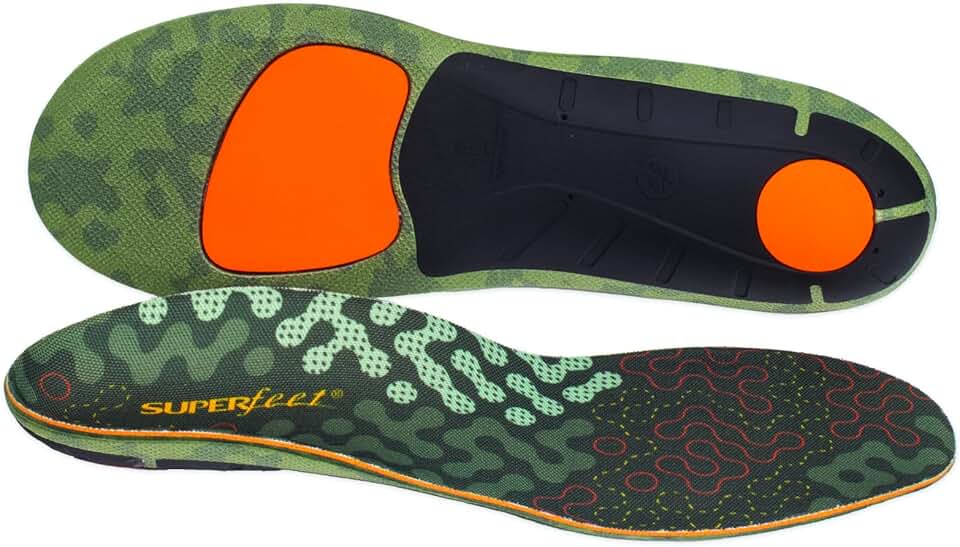
Superfeet has built a strong reputation in the hiking community, and their Hike Cushion model is specifically designed for trail use. These insoles feature adaptive comfort technology that provides responsive cushioning while maintaining structured support. The high arch support makes these particularly well-suited for hikers with medium to high arches who need substantial elevation under the midfoot.
What sets these apart from other Superfeet models is the enhanced cushioning system designed specifically for the impact and varied terrain of hiking. The cushioning is strategically placed in the heel and forefoot areas where you need shock absorption most, but it does not compromise the firmness of the arch support. This design addresses both comfort and support priorities that matter on long hikes.
The deep heel cup on these insoles is among the most pronounced in the category, which helps with stability on uneven ground and steep descents. If you have struggled with your foot sliding forward in your boots on downhill sections, the heel cup design here can make a noticeable difference. The insoles currently have a limited-time deal bringing them down from the regular price, which makes them competitive with other premium options.
One consideration is that with 794 reviews, they have less customer feedback compared to some other options, though the reviews they do have are largely positive. The insoles are designed to fit hiking boots specifically, so the volume and shape work well in most boot styles without excessive trimming. They come in multiple sizes, and the sizing guide is straightforward for selecting the right fit. Read verified buyer reviews for the Superfeet Hike Cushion Insoles on Amazon.
Pros
- Designed specifically for hiking with adaptive cushioning
- High arch support ideal for medium to high arch feet
- Deep heel cup provides excellent stability
- Strategic cushioning in heel and forefoot areas
- Currently available at discounted price
Cons
- Limited customer feedback compared to other options
- High arch design may not suit flat-footed hikers
- Thicker profile requires adequate boot volume
3. Superfeet All-Purpose Support High Arch Insoles (Green)
Best versatile option for multiple activities including hiking

The Superfeet Green insoles are a proven option with over 34,000 customer reviews, making them one of the most widely tested insoles available. While marketed as all-purpose rather than hiking-specific, these insoles have earned a strong following among hikers because they deliver reliable high arch support in a durable package that holds up to trail conditions.
The biomechanical shape and high-profile arch support are designed to support the foot structure during activity. The structured heel cup stabilizes your foot and helps with alignment during movement. Unlike softer, more cushioned insoles, the Green model prioritizes support structure over plush comfort, which makes them particularly effective for the demands of hiking where stability matters.
These insoles have been on the market longer than most competitors, and the large volume of customer feedback provides confidence in their reliability. Many hikers report getting 6 months to over a year of regular use before needing replacement, which is solid durability for the price point. The current discounted price makes them more accessible than the regular retail cost.
One trade-off with these insoles is that they are not as hiking-specific as some other options, so they lack some of the targeted cushioning features designed specifically for trail impact. However, their proven track record and high arch support make them a reliable choice, especially if you want insoles that work well in both your hiking boots and everyday shoes. The moisture-wicking top layer helps manage sweat during long hikes. Check current stock for the Superfeet All-Purpose Support High Arch Insoles on Amazon.
Pros
- Over 34,000 customer reviews provide extensive feedback
- High-profile arch support effective for active use
- Excellent durability lasting 6-12 months of regular use
- Versatile design works in hiking boots and everyday shoes
- Structured heel cup aids stability and alignment
Cons
- Less hiking-specific cushioning than trail-focused models
- Firm design requires break-in period for some users
- High arch may be too aggressive for low-arched feet
View Superfeet All-Purpose Support High Arch Insoles (Green) on Amazon →
4. VALSOLE Heavy Duty Support Pain Relief Orthotics
Best for heavy-duty support for hikers over 220 pounds
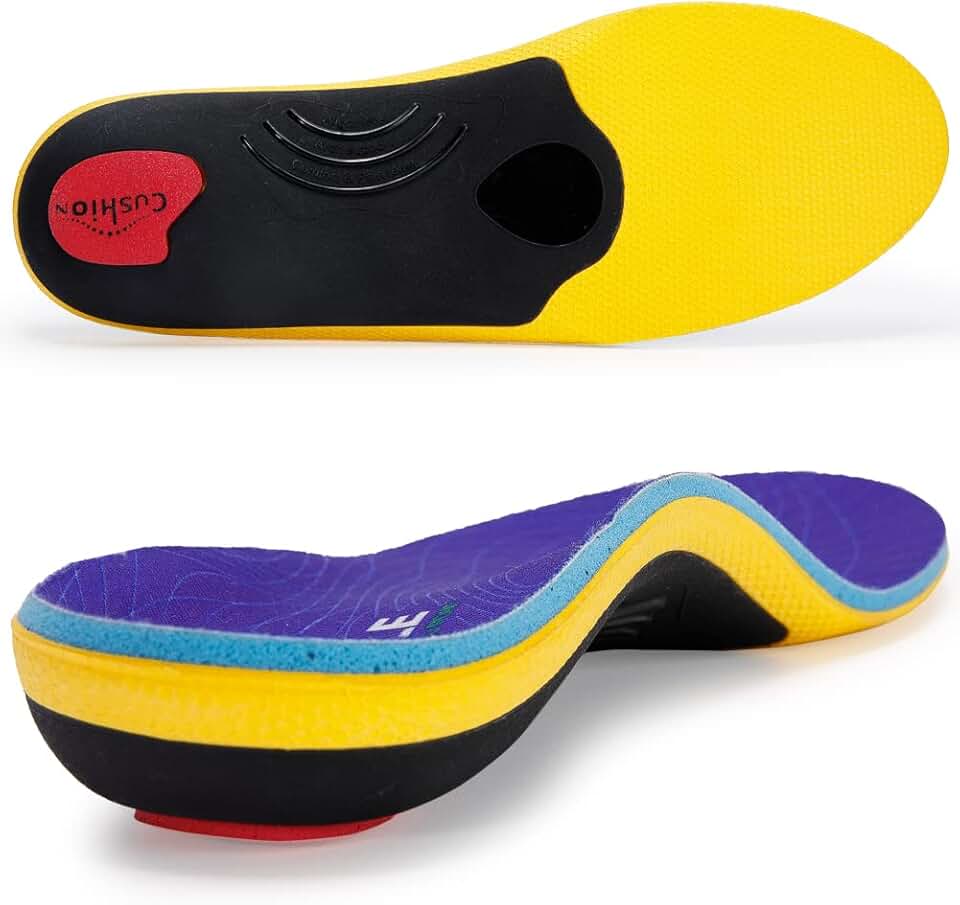
The VALSOLE Heavy Duty insoles are specifically designed for hikers and workers over 220 pounds who need robust support. With nearly 29,000 customer reviews and Amazon Choice recognition, these insoles have proven their effectiveness across a wide range of users. The high arch support and heavy-duty construction make them particularly suitable for hikers who carry heavier packs or those whose body weight places additional stress on their feet.
What makes these insoles stand out is their shock absorption system designed to handle higher impact forces. Each step on the trail creates significant force, and for heavier hikers or those carrying substantial pack weight, this impact is amplified. The VALSOLE design incorporates materials that absorb shock with every step, which many users find helpful for all-day comfort on the trail.
The high arch support is substantial without being overly aggressive, and the structured design maintains its shape even under sustained pressure from long hikes. The materials used in these insoles meet quality standards for durability and construction, which matters when these insoles are in direct contact with your feet for hours on the trail.
At under $40, these insoles offer strong value, especially given their durability and the volume of positive customer feedback. They are designed to fit work boots and hiking boots, so the shape and thickness work well in most hiking boot styles. The insoles can be trimmed if needed, though most users report good fit without extensive modification. Compare the VALSOLE Heavy Duty Support Pain Relief Orthotics specs and pricing on Amazon.
Pros
- Specifically designed for users over 220 pounds
- Amazon Choice recognition with 28,884 reviews
- Excellent shock absorption for high-impact hiking
- Quality materials and construction
- Strong value at under $40
Cons
- May feel overly firm for lighter-weight hikers
- High arch design not suitable for flat feet
- Thicker construction requires adequate boot space
View VALSOLE Heavy Duty Support Pain Relief Orthotics on Amazon →
5. PowerStep Original Insoles
Best for tighter-fitting boots requiring lower-volume insoles

The PowerStep Original insoles offer a slimmer profile compared to the Pinnacle model, making them the ideal choice for hikers who have tighter-fitting boots or who have found that thicker insoles create fit issues. Despite the lower profile, these insoles still deliver meaningful arch support designed for active use.
With over 26,000 customer reviews, these insoles have been tested extensively in real-world conditions. The lower profile does not mean compromised support. The arch support is still structured and firm, providing the features many hikers prioritize. The design is better suited for boots with less internal volume or for hikers who prefer a less aggressive arch feel while still getting therapeutic benefits.
The dual-layer cushioning system provides comfort without excessive bulk, and the anti-microbial top fabric helps manage odor during multi-day hikes or hot weather conditions when your feet sweat more. These insoles come from a brand with a reputation for quality construction and consistency.
These work particularly well if you have tried thicker insoles and found your boots felt too tight afterward. The Original model provides a middle ground between stock boot insoles and maximum-support options. They are designed for mild foot mechanics issues, so if you have significant concerns, you might need the more structured Pinnacle model instead. For many hikers who want effective support without dramatically changing their boot fit, these represent an excellent solution. See if the PowerStep Original Insoles are right for your first hike on Amazon.
Pros
- Lower profile fits tighter boots better than thicker options
- Over 26,000 reviews confirm effectiveness
- Maintains structured arch support despite slimmer design
- Quality construction from established brand
- Anti-microbial fabric helps manage odor
Cons
- Less cushioning than thicker insole models
- Mild support may not suit more significant needs
- Lower profile means less dramatic support feel
How These Compare
Choosing between these five insoles depends largely on your specific foot characteristics, boot fit, and hiking style. If you have moderate to high arches and want the most proven option backed by extensive customer feedback, the PowerStep Pinnacle insoles are your best bet. Their combination of structured support and dual-layer cushioning works for most hikers, and the 30,000-plus reviews provide confidence that they deliver results.
For hikers who want cushioning specifically optimized for trail conditions, the Superfeet Hike Cushion insoles are worth the investment. The adaptive comfort technology and strategic cushioning placement make them particularly effective on rough terrain and long descents where impact forces are highest. They are the newest design on this list, incorporating lessons learned from years of hiker feedback on what works on actual trails.
The Superfeet Green insoles represent the versatile option that works across multiple activities. If you want one pair of insoles that performs well in your hiking boots, work boots, and everyday shoes, these are the logical choice. They may not have hiking-specific features, but their proven high arch support and durability make them reliable for trail use.
Hikers over 220 pounds or those who carry heavy packs should strongly consider the VALSOLE Heavy Duty insoles. They are engineered specifically for higher weight loads and provide the shock absorption features designed for these demanding conditions. The lower price point makes them accessible without sacrificing the support features that matter.
Finally, if you have tighter-fitting boots or have struggled with thicker insoles making your boots feel cramped, the PowerStep Original insoles solve that problem. They prove you can get meaningful support without adding excessive bulk. The slimmer profile makes them easier to fit in a wider range of boot styles while still delivering the structured arch support hikers prioritize on the trail.
Frequently Asked Questions
How do I know what arch support I need for plantar fasciitis?
The arch support you need depends on your natural arch height and foot structure. A simple way to assess your arch type is the wet foot test: wet your foot and step on a surface that shows your footprint. If you see most of your foot including a wide connection between heel and forefoot, you likely have low arches or flat feet. If you see your heel and ball of foot with a thin connection, you have normal arches. If the connection is very thin or barely there, you have high arches.
For plantar fasciitis, the general guideline is that higher arches typically need more pronounced arch support to fill the space under the midfoot. Flatter feet often do better with medium arch support that gently supports without feeling like a pressure point. Many insoles specify whether they are designed for low, medium, or high arches. If you are between categories or unsure, medium arch support is usually a safe starting point. The support should feel like it is lifting and supporting your arch without causing discomfort or pressure. Some initial adjustment period is normal, but sharp pain or pressure points indicate the arch height may not be right for your foot structure.
Can insoles cure plantar fasciitis or just help with symptoms?
Insoles are designed to provide comfort features and foot support, but they are not a medical treatment or cure. Plantar fasciitis occurs when the plantar fascia (the band of tissue along the bottom of your foot) becomes inflamed due to strain, often from foot mechanics, overuse, or inadequate support. Quality insoles provide arch support, cushioning that decreases impact forces, and heel cups that promote proper foot positioning.
Many people find that consistent use of supportive insoles, combined with other measures like stretching and appropriate rest, helps them stay comfortable during activity. The insoles provide features that many users find beneficial for all-day comfort by supporting the foot structure during movement. However, if you simply wear the insoles without addressing other factors like tight calf muscles, overtraining, or worn-out footwear, you may not see the results you are hoping for.
Think of insoles as an important tool in your overall approach to foot comfort, not a standalone solution. They work best when combined with proper hiking technique, gradual increases in mileage, appropriate rest days, and stretching exercises for your calves and feet. If your symptoms persist despite using quality insoles and following these practices, consulting with a healthcare provider can help identify whether additional interventions are needed.
How long does it take to break in new insoles for hiking?
Most quality insoles require a break-in period of about 1 to 2 weeks of regular wear before they feel completely comfortable. During this time, your feet are adjusting to the new support structure, and the insole materials are conforming slightly to your unique foot shape. This is normal and expected, especially with insoles that have structured arch support.
For hiking specifically, it is wise to break in new insoles gradually rather than wearing them on a long trail adventure right away. Start by wearing them around the house for a few hours, then progress to short walks, and eventually work up to your normal hiking distances. This gradual approach allows your feet, ankles, and legs to adapt to the different support and alignment the insoles provide. Some people experience minor soreness in their arches or calves during the first few days as muscles adjust to working slightly differently.
If you experience sharp pain, significant discomfort, or develop new pressure points that do not improve after a week of gradual use, the insoles may not be the right fit for your feet. Mild discomfort during the adjustment period is normal, but ongoing pain is not. The break-in period should result in progressively increasing comfort, not worsening symptoms. Once fully broken in, quality insoles should feel supportive and comfortable from the start of your hike through the end.
Do I need to replace my hiking boot insoles regularly?
Yes, even quality insoles wear out over time and need replacement to maintain their effectiveness. Most hiking insoles last between 6 months and 1 year of regular use, though this varies based on how frequently you hike, your body weight, the terrain you cover, and how well you care for the insoles. Heavier hikers or those who carry substantial pack weight typically see faster breakdown of cushioning materials and support structures.
Signs that your insoles need replacement include visible compression or flattening in the heel or arch areas, deterioration of the top fabric, loss of the structured feel in the arch support, or return of discomfort that had previously improved. You can also perform a simple test: place the insoles on a flat surface and look at them from the side. If the arch support has visibly collapsed or the heel area is significantly compressed compared to when they were new, replacement is due.
Some hikers keep two pairs of the same insole and rotate them between hikes, which can extend the life of both pairs by allowing materials to fully decompress between uses. It is also helpful to remove insoles from your boots after hikes and let them air dry, which prevents moisture damage and bacterial growth that can degrade materials faster. Investing in quality insoles that last 6 to 12 months is worthwhile when you consider they are protecting you from discomfort that could sideline you from hiking for extended periods.
The Bottom Line
Finding the right insoles can improve your hiking experience significantly. The five options reviewed here represent proven choices that have helped thousands of hikers continue pursuing their trail goals. Your best choice depends on your specific needs and circumstances.
If you are just starting to address foot discomfort and want the most widely proven option, go with the PowerStep Pinnacle insoles. Their combination of professional recommendations, extensive customer feedback, and effective arch support makes them a safe choice for most hikers. If you specifically need maximum cushioning for rough trails and steep descents, the Superfeet Hike Cushion insoles are purpose-built for hiking conditions.
For hikers who want one insole that works across multiple types of footwear, the Superfeet Green insoles provide versatile high arch support that transitions easily from hiking boots to work boots to everyday shoes. If you weigh over 220 pounds or carry heavy packs, the VALSOLE Heavy Duty insoles are engineered for your needs with reinforced shock absorption. And if you have tighter-fitting boots where thicker insoles create fit problems, the PowerStep Original insoles deliver necessary support in a lower-profile design.
Remember that insoles are one component of managing foot comfort. Pair them with proper stretching, gradual mileage increases, and attention to your overall foot health. Take time to break in new insoles gradually before attempting long hikes. If you experience persistent discomfort, consult with a healthcare provider for personalized guidance. With the right insoles and a thoughtful approach to foot care, you can keep hiking the trails you love.
Disclosure: As an Amazon Associate, we earn from qualifying purchases. This does not affect our editorial recommendations.