
Finding the best lightweight hiking backpack for women is not about settling for a smaller version of a men’s pack – it is about getting a design that actually fits your body. Women-specific packs account for shorter torso lengths, narrower shoulder widths, and different hip shapes, which means better weight distribution and less strain on longer hikes. The difference between a pack that fits and one that does not becomes obvious after a few miles on the trail.
This guide reviews the best lightweight hiking backpack for women across different capacities and price points. Whether you are planning day hikes, overnight trips, or multi-day backpacking adventures, these packs are built with features that matter – adjustable torso lengths, load-lifter straps, padded hip belts, and enough capacity for your gear without unnecessary bulk. Each recommendation is based on verified customer feedback and real-world performance.
What to Look For
Torso Length and Fit Adjustability
The most critical factor in backpack comfort is torso length, not overall height. Your torso length is measured from the C7 vertebra at the base of your neck to the top of your hip bones. Women-specific packs are designed to accommodate the torso proportions typical of female body types. Many quality women’s packs offer adjustable torso systems that let you dial in the fit by moving the shoulder harness up or down on the frame. This adjustment ensures the hip belt sits on your hips (not your waist) and the shoulder straps curve naturally over your shoulders without gaps or pressure points.
Hip Belt Design and Load Transfer
A properly designed hip belt for women is contoured to fit wider hip bones and angled to follow the natural shape of the female pelvis. The hip belt should carry 80 percent of the pack weight, not your shoulders. Look for hip belts with substantial padding, at least 3 inches wide, with pockets for snacks or a phone. The belt should wrap around your hips and fasten in front with at least 2 inches of strap to spare on each side – if it barely closes or has excessive leftover strap, you need a different size. Women’s hip belts are typically set at a different angle than men’s to account for the difference in hip-to-waist ratio.
Shoulder Strap Shape and Spacing
Women’s shoulder straps are narrower set, shorter, and more curved than men’s straps to accommodate narrower shoulders and chest anatomy. The straps should rest flat against your collarbones and chest without gapping or pulling. Adjustable sternum straps help stabilize the load and should sit about 2 inches below your collarbone. Load-lifter straps connect the top of the shoulder straps to the pack frame and angle upward at roughly 45 degrees when properly adjusted – these pull the pack closer to your back and transfer weight off your shoulders.
Capacity and Volume Considerations
Backpack capacity is measured in liters and corresponds to trip length and season. A 20 to 30-liter pack handles day hikes with layers, food, and safety gear. A 30 to 50-liter pack accommodates overnight trips with sleeping bag, pad, and extra clothing. A 50 to 65-liter pack supports multi-day trips with bear canister, cooking gear, and more substantial food loads. Do not assume you need less capacity than a male hiking partner – your gear volume depends on trip length and weather, not gender. Women-specific packs in the same capacity range as men’s packs simply distribute the weight differently.
Weight and Pack Construction
The best lightweight hiking backpack for women balances low weight with durability. Packs under 3 pounds typically sacrifice some padding and feature robust frames for weight savings. Packs between 3 and 4 pounds offer more cushioning and organizational pockets. Packs over 4 pounds include full suspension systems and extra features. Lighter is not always better – a too-light pack without adequate hip belt padding or frame support will feel heavier under load than a slightly heavier pack that transfers weight properly. Look for ripstop nylon or polyester fabrics in the 210 to 420 denier range for good durability without excessive weight.
Hydration System Compatibility and Access
Most modern hiking packs include either an internal sleeve for a hydration reservoir or external pockets for water bottles. Reservoir sleeves sit against your back with an exit port for the drinking tube, keeping water weight close to your body. Side stretch pockets let you grab a bottle without removing your pack. Some packs offer both options. Consider how you prefer to drink on the trail – reservoirs provide hands-free hydration but are harder to monitor and refill, while bottles are easier to track and fill but require stopping to access unless you have front shoulder strap pockets.
Our Top Picks
1. Osprey Tempest 22L Women’s Lightweight Hiking Backpack
Best overall for day hikes and shorter overnight trips requiring lightweight carry with women-specific fit

The Osprey Tempest 22L delivers the best balance of capacity and fit adjustability for female day hikers and light overnight users. The back panel uses tensioned mesh to create airflow between your back and the pack, reducing sweat buildup on warm days. The harness and hip belt are specifically contoured for women with narrower shoulder spacing and angled hip belt wings that wrap naturally around female hip anatomy.
At 22 liters, this pack holds a full day’s worth of gear including extra layers, food, first aid kit, and safety equipment with room to spare. The main compartment opens via a large zippered panel for easy access to packed items without digging from the top. Dual stretch mesh side pockets accommodate water bottles, and the front panel includes additional stretch mesh for stashing a jacket or wet gear. The internal hydration sleeve accepts bladders with an exit port for the drinking tube.
The hip belt includes zippered pockets on each side, perfect for keeping your phone, snacks, or lip balm within easy reach without removing your pack. Trekking pole attachments on the front allow you to secure poles when not in use. The pack includes a built-in raincover stored in the bottom compartment, which deploys quickly when weather changes. Load-lifter straps above the shoulders fine-tune the fit and pull the pack closer to your back for better balance on uneven terrain.
With 251 verified reviews and a 4.6-star rating, users consistently praise the comfortable fit right out of the box and the thoughtful organization for day hiking essentials. The lightweight construction makes it easy to carry when empty while remaining sturdy enough to handle full day hiking loads comfortably. The women-specific sizing accommodates a range of torso lengths with adjustment built into the harness system.
See current pricing for the Osprey Tempest 22L Women’s Lightweight Hiking Backpack on Amazon.
Pros
- Women-specific shoulder harness and hip belt provide excellent weight distribution
- Tensioned mesh back panel reduces back sweat on warm days
- Built-in raincover protects gear in unexpected weather
- Hip belt pockets keep essentials accessible without stopping
- 22-liter capacity handles day hikes and light overnight trips
Cons
- Not designed for heavy loads over 20 pounds
- Side pockets may be tight for larger water bottles
View Osprey Tempest 22L Women’s Lightweight Hiking Backpack on Amazon →
2. Osprey Tempest 20L Women’s Hiking Backpack
Best for shorter day hikes and minimalist hikers who want proven durability with extensive customer feedback

The Osprey Tempest 20L represents the previous generation design with 945 verified reviews, making it one of the most tested women’s hiking packs available. This version uses the same women-specific harness geometry as newer models but in a slightly smaller 20-liter capacity. The reduced volume makes it ideal for shorter day hikes where you need layers, snacks, and water but not overnight gear.
The ventilated back panel provides airflow with foam ridges that channel air between your back and the pack. The internal frame transfers load to the padded hip belt, which wraps around female hip anatomy with angled wings. This hip belt design sits lower on the hips than unisex packs, matching where women naturally carry weight. Dual side stretch pockets hold water bottles or gear, and a front stretch mesh pocket stashes layers you shed as you warm up on the trail.
The extended fit option accommodates longer torsos, with the harness adjustable to fit various body types. A hydration reservoir sleeve accepts bladders with an internal exit port for the tube. Trekking pole loops on the lower front let you secure poles when scrambling or when they are not needed.
With 945 reviews averaging 4.7 stars, this pack has a proven track record across diverse conditions and user body types. Hikers consistently mention the pack breaks in quickly without rubbing or pressure points. The 20-liter capacity forces you to pack efficiently but rewards you with a lighter overall carry. The construction is lightweight enough to feel minimal when properly adjusted.
Read verified buyer reviews for the Osprey Tempest 20L Women’s Hiking Backpack on Amazon.
Pros
- 945 customer reviews provide extensive real-world feedback
- Women-specific hip belt and harness fit smaller frames well
- 20-liter capacity encourages efficient packing without bulk
- Internal frame provides structure for moderate loads
- Extended fit option accommodates longer torsos
Cons
- Slightly smaller capacity limits gear options for longer hikes
- No built-in raincover like the 22L version
3. Osprey Kyte LT 35L Women’s Backpacking Backpack
Best for overnight and multi-day trips requiring more capacity with lightweight construction
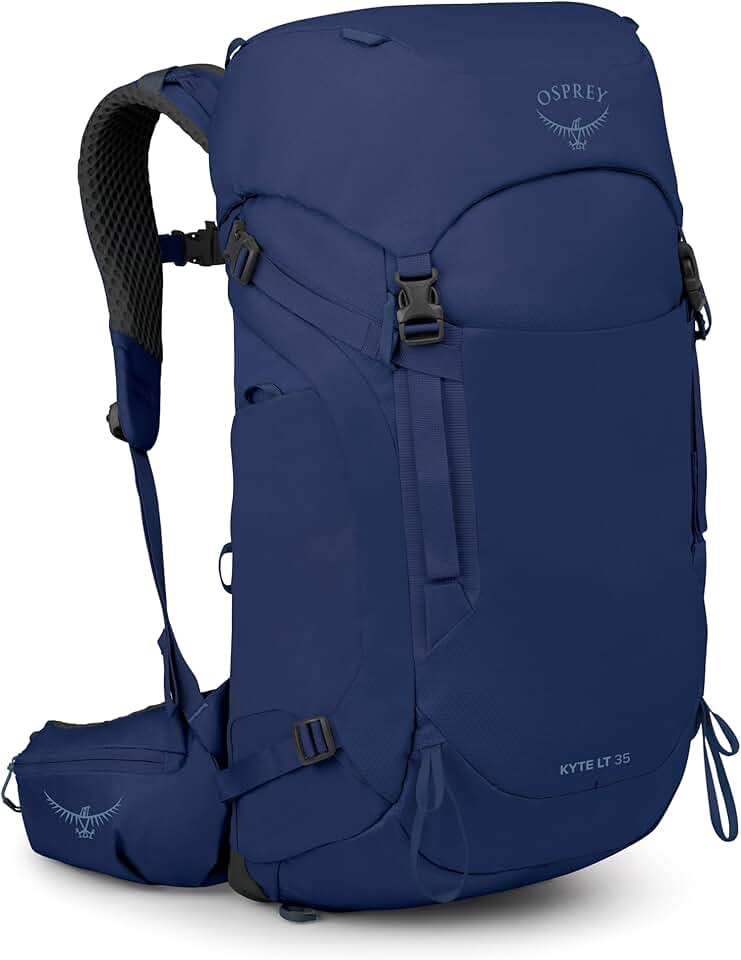
The Osprey Kyte LT 35L extends capacity to 35 liters for overnight and multi-day trips while maintaining a lightweight profile. The LT designation stands for light, indicating Osprey stripped unnecessary features to reduce weight without sacrificing the women-specific fit that defines the Kyte line. This pack handles weekend trips with sleeping bag, pad, extra clothing, and food without feeling overbuilt.
The removable top lid provides organizational options, letting you configure the pack for different trip types. The main compartment opens via a U-shaped zipper for full access to packed gear, and a separate sleeping bag compartment at the bottom keeps your bag isolated from other items. An internal hydration sleeve accepts bladders with routing for the drinking tube.
The suspension uses a tensioned mesh back panel that suspends away from your back, creating substantial airflow in warm conditions. The women-specific hip belt includes dual zippered pockets and padded wings that angle to match female hip anatomy. Shoulder straps are narrower set and more curved than unisex designs. The pack includes adjustable torso length to fit a range of body types.
Dual side stretch pockets hold water bottles or wet gear, and external compression straps cinch the load closer to your body for better balance. The included waterproof raincover deploys from the bottom compartment to protect gear in sustained rain. Trekking pole attachments and ice axe loops accommodate technical gear for more demanding terrain. With a 4.9-star rating from 28 reviews, early feedback reports excellent comfort for moderate loads, though the limited review count means this pack has less extensive real-world testing than other options in this guide.
Check current stock for the Osprey Kyte LT 35L Women’s Backpacking Backpack on Amazon.
Pros
- 35-liter capacity handles overnight and weekend trips with full gear
- Removable top lid provides configuration flexibility
- Tensioned mesh back panel maximizes ventilation in warm weather
- Women-specific fit with adjustable torso length accommodates various body types
- Separate sleeping bag compartment organizes gear efficiently
Cons
- Higher price point reflects premium features and construction
- Limited customer feedback with only 28 reviews so far
View Osprey Kyte LT 35L Women’s Backpacking Backpack on Amazon →
4. Deuter Speed Lite 23L SL Women’s Hiking Backpack
Best for hikers who prioritize ventilation and want an alternative to Osprey with European design

The Deuter Speed Lite 23L SL offers a European approach to women-specific pack design with the SL designation indicating Slim Line fit for narrower shoulders and shorter torsos. Deuter uses a back system with mesh panel that arches away from your back, creating an air gap that reduces heat buildup. This system excels in warm climates or during high-exertion activities where back sweat becomes a comfort issue.
The 23-liter capacity sits between day hiking and light overnight use, with enough room for extra layers, food, water, and safety gear with space remaining for a compact sleeping bag if needed. The top lid provides quick access to frequently used items, and the main compartment opens via a drawstring closure with a cinch top. Side compression straps pull the load tight against your back for better balance on uneven terrain.
The SL-specific hip belt wraps around female hip anatomy with a different angle than the standard version, and the shoulder straps are narrower set with more curve to avoid pressure on the chest. Load-lifter straps above the shoulders adjust the angle of pull, transferring weight to your hips rather than shoulders. The pack includes an internal hydration system compatible sleeve and external attachment points for trekking poles or an ice axe.
With 357 reviews averaging 4.4 stars, users report the Deuter fit runs slightly different from Osprey – some find it more comfortable, others prefer Osprey’s geometry. The lightweight construction uses ripstop fabric for tear resistance. Side mesh pockets hold water bottles, and a front zippered pocket organizes small items like headlamps or snacks.
Compare the Deuter Speed Lite 23L SL Women’s Hiking Backpack specs and pricing on Amazon.
Pros
- Arched mesh back system creates maximum ventilation gap
- SL-specific fit designed for narrower shoulders and shorter torsos
- 357 reviews provide substantial real-world feedback
- European design offers fit alternative to Osprey geometry
- Lightweight ripstop fabric construction
Cons
- Drawstring top closure slower to access than zippered panels
- Fit may differ from American brands – try before long trips if possible
View Deuter Speed Lite 23L SL Women’s Hiking Backpack on Amazon →
5. Osprey Sirrus 34L Women’s Hiking Backpack
Best for serious multi-day trips requiring maximum capacity and premium suspension system

The Osprey Sirrus 34L represents the top end of the lightweight backpacking category for women, offering 34 liters of capacity with a sophisticated suspension system that handles heavier loads. This pack bridges the gap between day hiking and expedition backpacking, suitable for three to four-day trips or longer outings in cold weather when gear volume increases. The suspension uses a tensioned mesh back panel with peripheral frame that transfers load to the hip belt while maintaining ventilation.
The hip belt is heavily padded with dual zippered pockets and wraps around female hip anatomy with pronounced contouring. Shoulder straps are women-specific with narrower spacing and more curve. The adjustable torso length accommodates a range of body types, with the harness sliding up or down the back panel to match your specific torso measurement.
The main compartment features a J-zip that opens the front panel for full access to packed items, eliminating the need to unpack from the top. A separate sleeping bag compartment at the bottom includes an internal divider that can be removed when you need the full volume as one large space. The top lid is removable and converts to a small daypack or waist pack for side trips from base camp. An internal hydration sleeve accepts bladders with an exit port for the drinking tube.
Dual stretch mesh side pockets hold water bottles, and lower compression straps let you attach extra gear or a sleeping pad externally. The pack includes a built-in high-visibility raincover and reflective attachment points for low-light safety. With 393 reviews averaging 4.7 stars, users consistently mention this pack excels for loads between 20 and 35 pounds, making it ideal for multi-day trips with full camping gear. The construction is more substantial than minimalist options but justified by the enhanced suspension and organizational features.
See if the Osprey Sirrus 34L Women’s Hiking Backpack is right for your first hike on Amazon.
Pros
- 34-liter capacity handles multi-day trips with full camping gear
- Adjustable torso length fits a wide range of body types
- Convertible top lid becomes a daypack for camp-based exploring
- J-zip front panel access eliminates top-down unpacking
- 393 reviews confirm reliable performance across diverse conditions
Cons
- Higher price reflects premium suspension and feature set
- More substantial construction than ultralight minimalist options
How These Compare
Choosing the best lightweight hiking backpack for women depends on your typical trip length and how much gear you carry. For day hikes and short outings, the Osprey Tempest 20L and 22L models provide the lightest carry with enough capacity for essentials. The 22L version adds a built-in raincover and slightly more room, making it the better choice if you frequently encounter weather changes or prefer carrying extra layers. Both use the same women-specific harness and hip belt geometry that distributes weight properly on smaller frames.
The Deuter Speed Lite 23L SL offers an alternative fit philosophy for those who find European pack designs more comfortable. The arched mesh back system creates more ventilation space than Osprey packs, making it the top choice for hot climates or high-exertion activities. However, the drawstring closure and different shoulder strap geometry mean you should test the fit if possible before committing to longer trips.
For overnight and multi-day trips, capacity becomes the deciding factor. The Osprey Kyte LT 35L strikes the best balance between lightweight construction and sufficient volume for weekend trips with sleeping bag, pad, and cooking gear. The removable top lid adds versatility for base camp situations. The Osprey Sirrus 34L offers similar capacity but with a more robust suspension system that handles heavier loads more comfortably – choose this option if you regularly carry camera gear, winter equipment, or food for multiple people.
Price follows capacity and features in a logical progression. The Tempest 20L at $119.95 represents the most affordable entry point with proven performance across 945 reviews. The Kyte LT and Sirrus models command higher prices but deliver features that matter for longer trips: convertible or removable lids, separate sleeping bag compartments, and suspension systems engineered for heavier loads. All five packs prioritize women-specific fit over simply scaling down men’s designs, which translates to better comfort regardless of which capacity you choose.
Frequently Asked Questions
What is the difference between a women’s hiking backpack and a unisex backpack?
Women’s hiking backpacks are engineered with specific anatomical differences, not just smaller sizes. The torso length on women’s packs accommodates the shorter distance between shoulders and hips, typically 15 to 19 inches compared to 18 to 22 inches for men. Shoulder straps are narrower set to match narrower shoulder width and curve more pronouncedly to avoid pressure on the chest. Hip belts on women’s packs angle differently and sit lower to match the female pelvis shape, which has a higher hip-to-waist ratio than male anatomy. The padding distribution in hip belts is contoured to wider hip bones. These differences matter because proper fit determines how efficiently the pack transfers weight to your hips rather than your shoulders, which directly affects comfort and endurance on longer hikes.
How do I measure my torso length for a hiking backpack?
To measure your torso length, tilt your head forward and feel for the bony bump at the base of your neck – this is your C7 vertebra and the top of the measurement. Place your hands on your hips with thumbs pointing backward, and draw an imaginary line between your thumbs across your lower back – this is your iliac crest and the bottom of the measurement. Have someone measure the distance between these two points with a flexible tape measure while you stand naturally. Most women’s torso lengths fall between 15 and 19 inches. This measurement determines which pack size you need and how to set the adjustable harness. Some packs come in specific torso sizes while others offer adjustment ranges. Measure before buying because an incorrect torso fit causes the hip belt to sit on your waist instead of your hips, putting all the weight on your shoulders.
What size backpack do I need for day hiking versus overnight trips?
Day hiking typically requires 20 to 30 liters of capacity to hold water, food, extra layers, first aid supplies, and safety equipment. A 20-liter pack works for shorter day hikes in mild weather when you need minimal gear. A 25 to 30-liter pack accommodates day hikes where you bring extra clothing layers, more food, or additional safety gear. Overnight trips require 30 to 50 liters to fit a sleeping bag, sleeping pad, extra clothing, and food for two days. Weekend trips of two to three nights need 40 to 50 liters. Longer trips of four or more nights benefit from 50 to 65 liters, especially in cold weather when gear volume increases. These ranges assume you pack efficiently and use appropriately sized sleeping bags and pads. Your specific needs also depend on whether you carry group gear like a tent or cooking equipment.
Should I get a pack with a hydration reservoir or water bottle pockets?
Both hydration systems work well but serve different preferences. Hydration reservoirs sit inside a sleeve against your back with a tube that routes over your shoulder, allowing you to drink without stopping or removing your pack. This convenience encourages better hydration during active hiking. However, reservoirs make it harder to monitor water levels, require more cleaning effort, and can be difficult to refill on the trail. Water bottles in external side pockets require you to stop and remove your pack to drink, but they let you see exactly how much water remains and refill quickly at streams or trailheads. Some packs include both options – a reservoir sleeve inside and stretch pockets outside – giving you flexibility to choose based on the specific hike. For hot weather or long water carries, the hands-free convenience of a reservoir often wins. For shorter hikes with frequent water sources, bottles offer simplicity.
The Bottom Line
The best lightweight hiking backpack for women depends on your typical hiking style and trip length. For most day hikers, the Osprey Tempest 22L offers the ideal combination of capacity, weight, and women-specific fit at a reasonable price point. The built-in raincover and hip belt pockets add practical value for variable weather and quick access to essentials. If you primarily take shorter day hikes and want to minimize weight, the Tempest 20L provides proven reliability with 945 customer reviews confirming its durability across diverse conditions.
For overnight and weekend trips, the Osprey Kyte LT 35L delivers the capacity you need without excessive weight. The removable top lid adds versatility for base camp scenarios, and the women-specific suspension handles moderate loads comfortably. Hikers planning more ambitious multi-day trips or carrying heavier loads should consider the Osprey Sirrus 34L with its enhanced suspension system and organizational features designed for extended use.
The Deuter Speed Lite 23L SL presents the best alternative for those who find European pack geometry more comfortable or who prioritize maximum ventilation in hot climates. The arched mesh back system creates more air circulation than most competitors, though the fit differs enough from Osprey designs that trying it on before committing makes sense. Regardless of which pack you choose, proper fit matters more than any specific feature – a perfectly fitted 20-liter pack will feel more comfortable than a poorly fitted 35-liter pack with premium features.
Disclosure: As an Amazon Associate, we earn from qualifying purchases. This does not affect our editorial recommendations.